5 things to check before modernising a legacy system
An old program can run for years, until the one person who understands it leaves. Five short checks show whether it needs changing, what to find out first and how to replace it part by part. They apply whether it is an Access database, an Excel file, a FoxPro application, a program built to order long ago or another program.
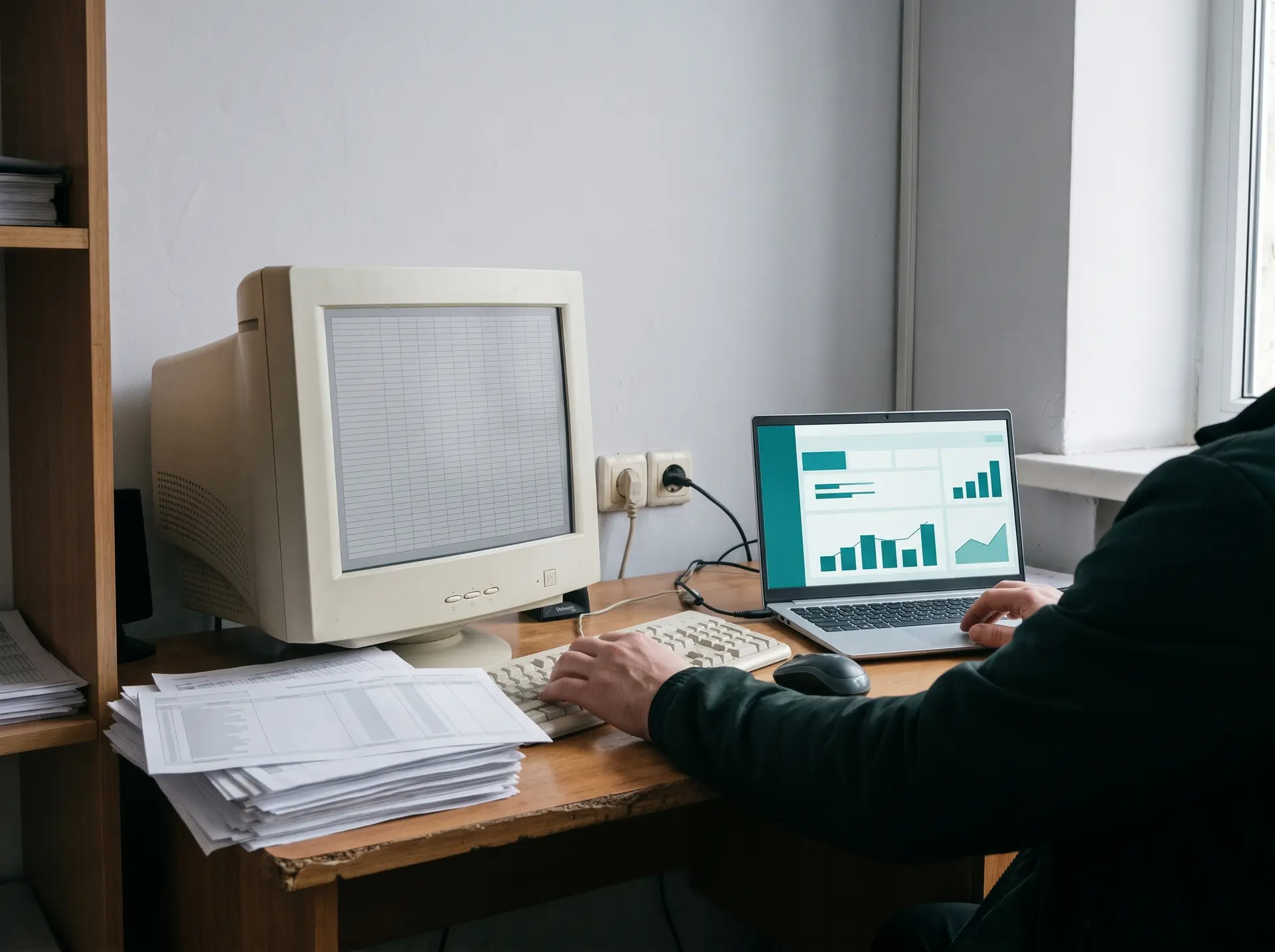
Does the old program need changing, and how?
A program that does its job does not always need new code. If there is a copy of the data and a second person who understands it, putting it in order is often enough, and we say so. It is time to change it when only one person understands it, it runs only on the office computer, it will not start on a newer version of Windows, it does not connect to the website or to 1C, data is typed in twice, or several people cannot work in it at once. Then there are three ways forward: a ready-made program; a rewrite from scratch, sometimes cheaper for a small system with few links; or modernisation in stages, for a system the whole business relies on.
How to check it in five minutes
- Write down what the program does on an ordinary day: who works in it, which documents it produces and what is typed by hand somewhere else.
- Note who fixes it when it breaks, where the latest copy of the data is and which computers it still starts on.
- Ask for a written quote for the audit with a fixed price and a deadline. The audit report then says whether tidying up, a rewrite or replacement in stages is the right way forward.
What to ask the developer
- What will the audit show about our program: tidying up, a rewrite from scratch or replacement in stages?
- How long does the audit take, what is its fixed price and what do we receive at the end?
Who holds the code, the database and the passwords?
The first thing we ask for on an old program is the access list. The source code, the database, the computer or server it runs on, the domain, the accounts and the licences may sit in the name of someone who no longer works at the company. If the rights to the code sit with the former developer or a vendor, the audit shows it, along with the steps the company takes. Work starts only with the company’s written consent and only on code it has the right to change. Without the source code, features are rebuilt from the running program and the data.
How to check it in five minutes
- Make a list: source code, database, computer or server, domain, accounts and licences, and whose name each one is in.
- Try to open each one from a company account, not from an employee’s account or the former developer’s.
- Find the contract with whoever wrote the program and note what it says about the rights to the code.
What to ask the developer
- What access does the audit find missing, and what steps do we take for each?
- How does the work go if the source code is missing or the rights to it sit with someone else?
The data in the old program: what moves and how it is checked
The data is the most valuable part of an old program. Clients, orders, stock and history move over from Access, Excel, FoxPro or an export from another program, and the history stays easy to find. Each transfer is checked against the source: record counts, totals and samples chosen by the team. Duplicates and errors found are shown to the company before the move, so it decides what stays.
How to check it in five minutes
- Note where the data lives today: the program’s files, the spreadsheets next to it and the paper that never made it into the program.
- Pick three old records the team knows well, for example an order, an invoice and a client card, to look up after the move.
- Ask for the quote to say how each transfer is checked and who signs off the result on the company’s side.
What to ask the developer
- How is each transfer checked against the data in the old program?
- What happens to the duplicates and errors found, and who decides what stays?
The program is replaced part by part, not in one day
A common mistake is rewriting the whole program at once and switching over in a single day. It is safer part by part: first one part, for example orders, then stock. The old part keeps working until the new one has been checked on a copy of the real data. Switching each part over needs a short pause for the last transfer, agreed with the team in advance. Each stage has its own fixed price, and the work can stop after any of them.
How to check it in five minutes
- Pick the part that gets in the way most today. It usually goes first.
- Agree who on the team learns the new part before the switch, and pick a quiet day for the pause.
- Links to the website, the accounting program and 1C move with their part. 1C stays as it is: its configuration is not changed, and any change inside 1C is made by the company’s 1C partner, to a format agreed in writing.
What to ask the developer
- Which part is replaced first, and how long is the pause when it switches over?
- What happens to the links to the website, accounting and 1C as each part moves?
What the company receives at handover, so another team can carry on
A new program that only one person understands repeats the old problem. So the code sits in the company’s repository, and the accounts and the server are in its name. The system is built with widely used web technologies and documented, so another team can carry on the work. The contract transfers the economic rights to the code written for the project. The studio stays after launch.
How to check it in five minutes
- Sign the data processing agreement (Law 195/2024) before any access to the database; the database copy is kept only for the duration of the work.
- Before launch, ask for the quote to state the monthly server cost and what can be changed without a developer.
- Check that the contract transfers the economic rights to the code written for the project and that the documentation is part of the handover.
What to ask the developer
- What does the company receive at handover: the code, the documentation, the accounts and the access?
- What do the servers cost per month after launch, and what can change without a developer?
The short list
- It is clear whether the program is tidied up, rewritten or replaced in stages, and the audit has a fixed price and a deadline.
- The code, database, server and accounts are on the access list, and whatever is missing has written steps.
- The data moves with a check against the source, and duplicates and errors are shown to the company before the move.
- The parts are replaced one at a time, each checked on a copy of the real data, with the switch pause agreed in advance.
- The code, documentation, accounts and monthly cost are settled in writing, and the data agreement is signed before any access.
Questions to ask the developer
The questions show up here after a no or a not sure.
All five points are covered.
- What will the audit show about our program: tidying up, a rewrite from scratch or replacement in stages?
- How long does the audit take, what is its fixed price and what do we receive at the end?
- What access does the audit find missing, and what steps do we take for each?
- How does the work go if the source code is missing or the rights to it sit with someone else?
- How is each transfer checked against the data in the old program?
- What happens to the duplicates and errors found, and who decides what stays?
- Which part is replaced first, and how long is the pause when it switches over?
- What happens to the links to the website, accounting and 1C as each part moves?
- What does the company receive at handover: the code, the documentation, the accounts and the access?
- What do the servers cost per month after launch, and what can change without a developer?

A program the company runs on should not depend on one person
That is how we approach modernisation: we start with the audit, not with new code, put the access in the company’s name first, move the data with checks and replace the program part by part, each stage at its own fixed price. What modernising an old system covers
A written quote within 3 working days
A few lines about the company and what the site or program should do are enough. We reply with the right questions, then with a written quote.