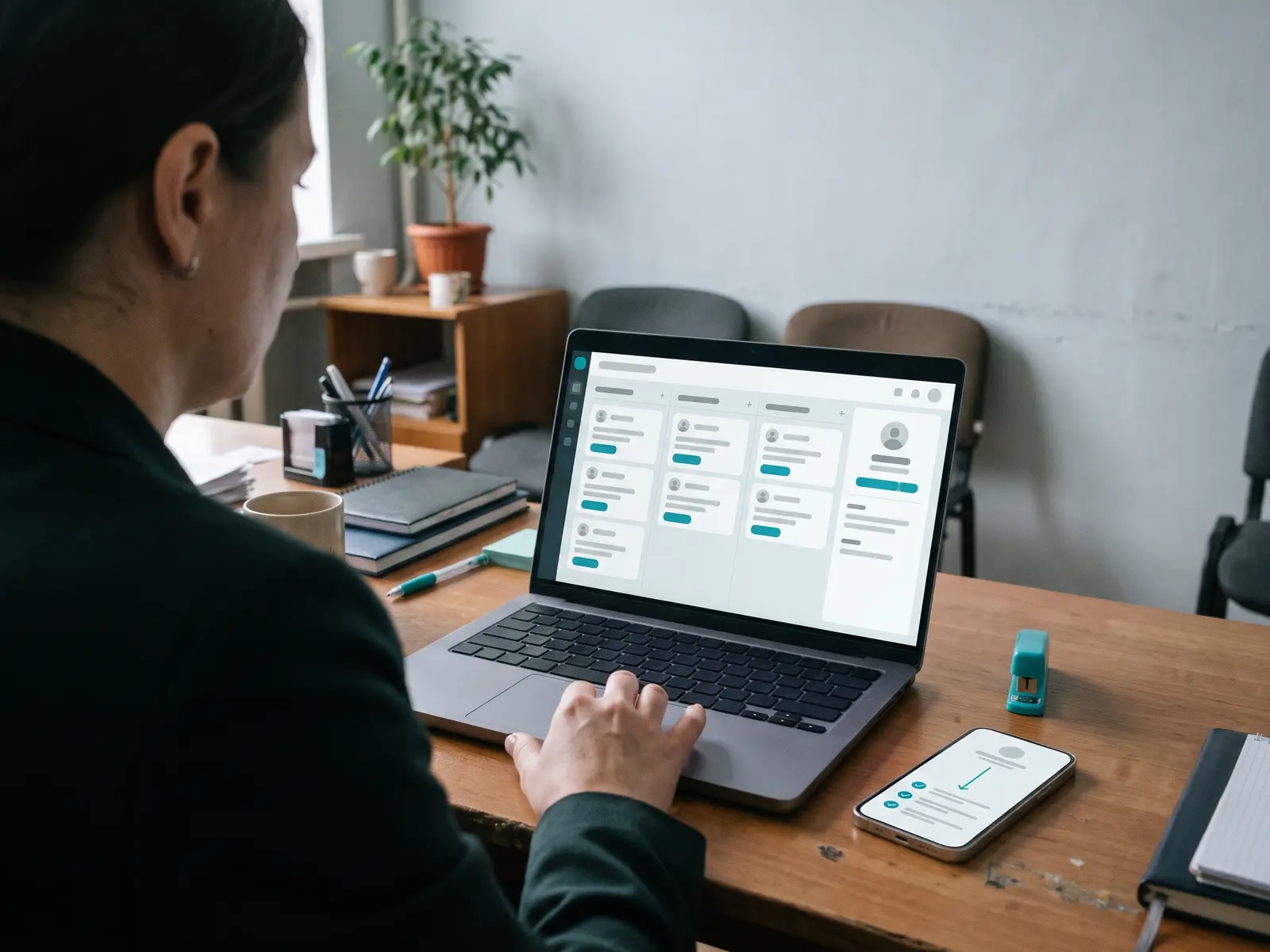
A custom CRM: what it includes
Five parts that can launch one at a time, starting with clients and deals. The CRM follows the stages the company already works by and connects to the programs it already uses.
-
Clients and deals, in one place
Every client with their history: calls, messages, orders and documents. Deals move through the company’s own stages, each with one person responsible, and every role sees only what it needs.
Every client, one person responsible
-
A portal for clients
Clients sign in to their own account, see the status of their order, their documents and invoices, and send files without long e-mail threads.
Fewer calls asking where an order is
-
Tasks and automation
Each stage can set its own tasks and reminders, notices go to the client by e-mail, SMS or the messenger the company already uses, and quotes and contracts are filled in from templates.
Tasks and reminders by the company’s rules
-
Links to the programs in use
The website form, e-mail, telephony, 1C or the accounting program, wherever the program or the operator allows a data exchange. The studio does not change the 1C configuration; a change inside 1C is made by the company’s 1C partner, to a format agreed in writing.
Nothing typed in twice
-
Reports for management
Deals by stage and by manager, where they stall and what was sold in a period, exported to Excel when needed.
Every sale, on one screen
-
Something else?
Several branches or departments, requests passed between departments, field staff working from a phone’s browser, or a SaaS product built around the company’s services. A few lines are enough; the answer comes within 3 working days.
Request a quote
How the CRM is built
In stages. Each delivered stage is paid separately, and the work can stop after any of them.
-
A few lines about the work
How clients and orders are tracked today, how many people work with them, which programs are in use and whether there is 1C, through the form on this page.
-
The quote, in writing
Within 3 working days: the price, the dates and what goes into each stage.
-
First stage: clients and deals in one place
Clients, deals and documents moved over from the spreadsheets, live and used by the team after training.
-
The next stages, by choice
The client portal, automation, links and reports, in the order that matters to the company.
Client history should stay with the company, not in a manager’s phone
- The code and every access are the company’s from day one, with no subscription per user.
- Client data stays on the server the company chooses and can be exported at any time. A data processing agreement is signed before any access.
- Payment per delivered stage. The work can stop after any stage, and everything done so far stays with the company.
- The monthly server and messaging cost, estimated in writing before work starts.
Before you write to us
How much does a custom CRM cost, and how long does it take?
Both depend on the number of roles and stages, the automation, the links to other programs and the client portal. The price and the dates come in a written quote within 3 working days. The first stage can be clients and deals alone.
A ready-made CRM or a custom one?
For a standard sales funnel and a small team, a ready-made CRM on a subscription is usually enough. A custom CRM makes sense when the work follows the company’s own stages and documents, clients need their own portal, data goes to and from 1C, or the per-user subscription grows with the team. A custom CRM has no fee per user; the server is sized to the team.
Can the data move over from spreadsheets or the current CRM?
Yes. Clients, deals and documents are imported from the spreadsheets or from the current CRM’s export, and the import is checked against the source in the first stage.
Can the CRM connect to 1C?
Yes, through the data exchange the 1C configuration already has. The configuration is checked before the quote. If the exchange is missing or something must change in 1C, the company’s 1C partner does that work, to a format agreed in writing.
Who sees the data, and where is it kept?
Each person sees what their role allows, and every change is recorded with who made it and when. The data sits on the server the company chooses, and the company keeps every access.
Can the team work from a phone?
Yes. The CRM opens in the phone’s browser, so managers and field staff have clients, tasks and orders with them on the road. It needs an internet connection.
What happens after launch?
The studio stays after launch. The CRM is designed so that stages, roles and templates change without a programmer, and every new stage gets its own written quote before it is built.
A written quote within 3 working days
A few lines about how clients and orders are tracked today and how many people work with them are enough. The quote holds the price, the dates and what goes into each stage.